Pockets: Reading the Aim Line, Choosing Power and Using Spin
Published by the Havfun team
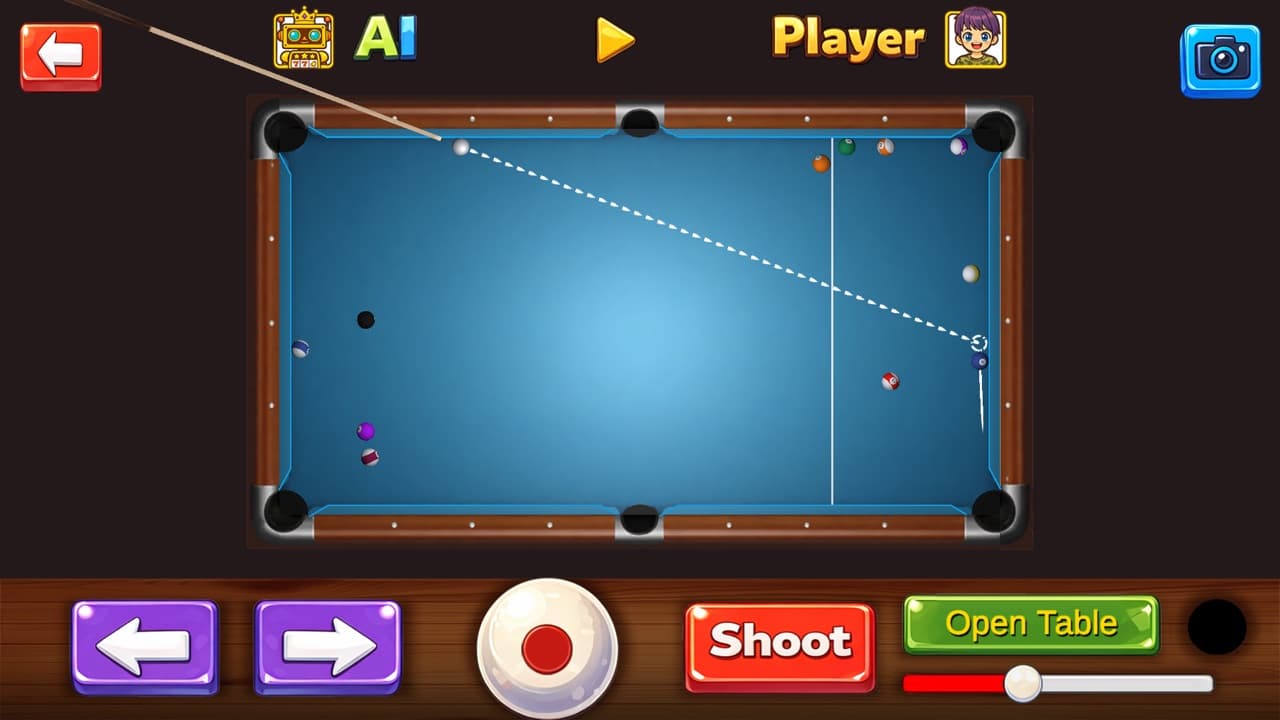
Pockets gives you a pool table, a computer opponent and no clock. Every shot can be lined up for as long as you like, which means most lost matches come from decisions and not from nerves: too much power, a spin that did nothing, a foul you did not know was a foul.
This guide goes through what the controls really do and how the rules are applied.
What the Aim Line Shows
The aim line runs from the center of the cue ball. Where it meets a ball, a marker shows where the cue ball will be at the moment of contact, and a short second line shows the direction the object ball will leave in.
That second line can be trusted. Balls in this game do not drag each other off course at contact, so the object ball goes exactly where the line points. If the line points at the middle of a pocket, the shot is on.
The line is short, though: about four and a half ball widths. For a long pot you have to extend it by eye. It also leaves three things out:
- It does not show where the cue ball goes after contact.
- It does not show rebounds off a cushion.
- It does not change when you add spin.
The first of these is the one that costs matches, because a cue ball that follows the object ball into the pocket is a foul. Before you shoot, picture the cue ball's path as well.
You can aim two ways. In the view from above, click or tap the table for a rough direction and use the arrow buttons to finish. In the view from behind the cue ball you aim with the arrows only, and they turn three times as fast, so use the top view for fine work.
How Much Power
The power slider goes back to the middle before each of your shots, and the middle is a hard shot. At half power a ball has enough speed to travel the length of the table several times over. Roughly a tenth of the slider is enough to send a ball one length of the table.
Most pots need far less than the default. A softer shot keeps the cue ball under control and makes a scratch less likely.
- For a ball near a pocket, bring the slider well down. It only has to arrive.
- On the break, use plenty. At least four balls must reach a cushion unless one is potted, or it is a foul.
- Do not roll a ball so gently that nothing reaches a cushion. That is a foul too.
Spin goes back to the center before each shot as well, so anything you want has to be set again every time.
When Spin Works
Spin in Pockets is used up at the cue ball's first contact, and which spin takes effect depends on what that contact is.
| Cue ball hits first | Top or back spin | Side spin |
|---|---|---|
| A ball | Takes effect: top carries the cue ball forward, back pulls it back | Lost |
| A cushion | Lost | Takes effect: the cue ball comes off the cushion to that side |
For an ordinary pot, then, side spin does nothing at all. The two spins worth using are back spin, to stop the cue ball following a ball into a pocket, and top spin, to carry it forward for the next shot. Side spin is only for shots that go off a cushion first.
Fouls and What They Cost
After any foul your opponent places the cue ball anywhere on the table, right up against another ball if they wish. That usually means an easy pot, so a foul costs more than a missed shot.
- Missing every ball, or hitting the wrong ball first.
- Potting the cue ball.
- In 8 Ball, potting one of your opponent's balls once the groups are set. This is a foul even if one of your own drops on the same shot.
- A shot on which nothing is potted and no ball reaches a cushion. The cue ball counts, and so does a cushion touched before contact.
- On the break, fewer than four balls reaching a cushion with nothing potted.
A ball that goes down on a foul stays down.
8 Ball: How Matches Are Lost
Your group is set by the first shot after the break that pots only spots or only stripes. Pot one of each on the same shot and the table stays open, and you carry on.
You win by potting the 8 after your group is cleared, on a shot with no foul. Every other way of potting the 8 loses the match on the spot:
- Potting it while the table is still open, including on the break.
- Potting it while any ball of your group is left.
- Potting it on a shot with a foul: a scratch, the wrong ball first, or another ball dropping with it.
The last one catches people at the very end. Do not pot your final ball and the 8 together. Take the 8 on a shot of its own, softly, with a touch of back spin if the cue ball is heading for the same pocket.
9 Ball: The Quicker Game
In 9 Ball the cue ball has to hit the lowest numbered ball first. After that any ball you pot keeps your turn, and the 9 wins the match the moment it drops without a foul, even on the break. Pot the 9 on a foul and you lose.
You do not have to clear the table in order to win. A shot that hits the lowest ball and sends it, or another ball, into the 9 is a legal way to finish. With nine balls on the table and a win available at any time, a game of 9 Ball is usually over sooner than a game of 8 Ball.
Wins, Restarts and the Leaderboard
Your leaderboard score is the number of matches you have won, and a win in 8 Ball counts the same as a win in 9 Ball. A loss does not lower it. Restarting a match or going back to the menu is not recorded as a loss.
Who breaks is drawn at random each time a match starts. The computer opponent does not use spin and does not play safety shots, and it can foul like any player, which hands you the cue ball.